LAIYA MACHINERY · TECHNICAL GUIDE
How to Choose a Stone Crusher Conveyor Belt
A stone crushing plant can use several conveyors, but the belts on them do not necessarily face the same working conditions. The belt directly below a crusher receives sharp, heavy pieces of rock, while a conveyor carrying screened sand may experience steady surface wear. Selecting the same rubber conveyor belt for every position can lead to unnecessary replacement costs or repeated failures.
When purchasing a stone crusher conveyor belt, begin with the material and operating conditions. Then check the belt’s rated strength, rubber covers and fit with the equipment before comparing prices.
1. Identify the material and the conveyor duty
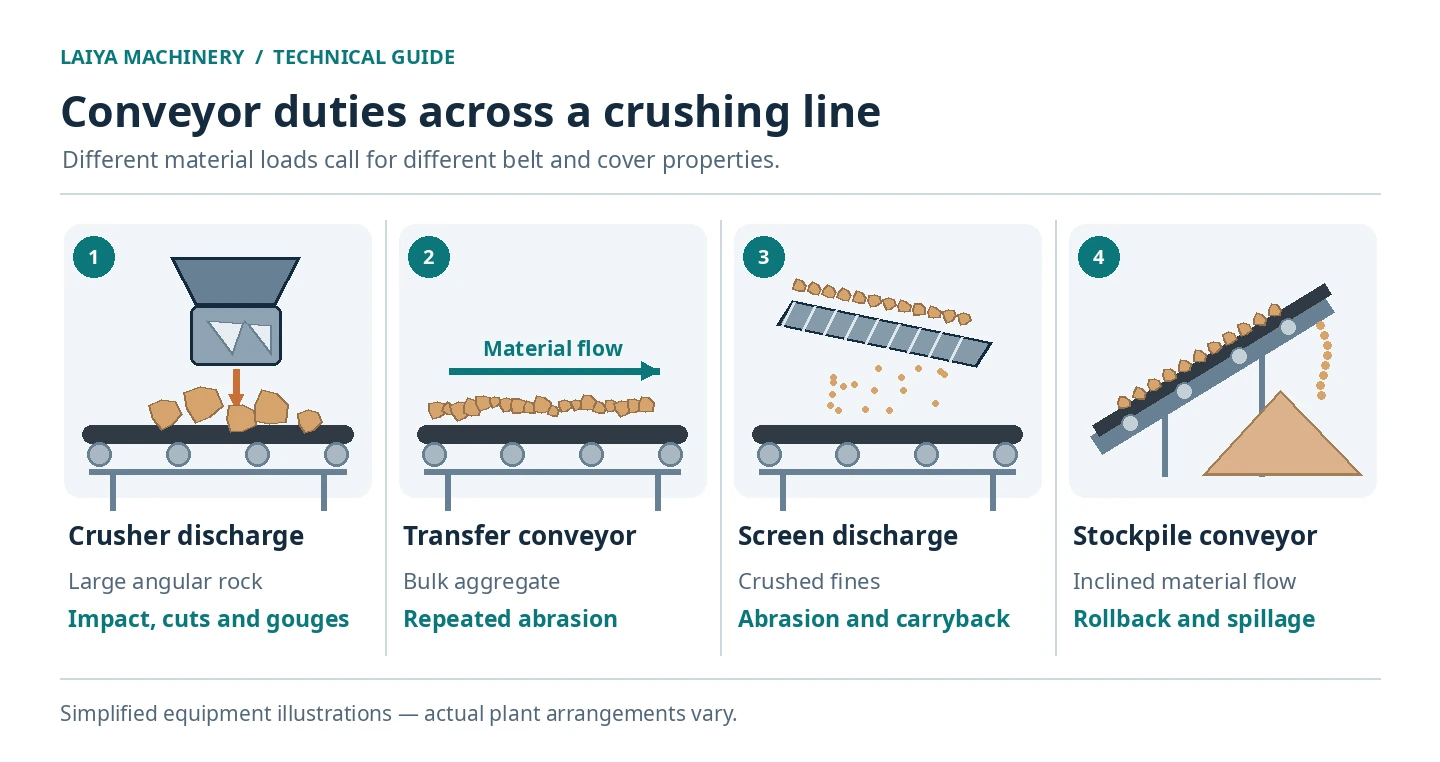
Start with the type of material being conveyed. Granite, limestone, basalt and other aggregates differ in hardness, particle shape and abrasive behavior. Record the maximum lump size, not just the average size. Large angular pieces can damage the belt locally when they fall from a chute, whereas fine crushed material can gradually wear away the carrying surface.
| Conveyor position | Typical challenge | What to prioritize |
|---|---|---|
| Crusher discharge | Sharp lumps and loading impact | Impact and cut resistance; suitable loading support |
| Transfer conveyor | Repeated sliding and abrasion | Wear-resistant rubber cover; controlled material transfer |
| Screen discharge or fines | Fine abrasive particles and carryback | Abrasion resistance; effective belt cleaning |
| Inclined stockpile conveyor | Material rollback and spillage | Belt profile and inclination suited to the material |
Also record the capacity in tonnes per hour, material moisture, feed drop height, belt speed and operating hours. A short conveyor with frequent loading cycles can still experience significant wear.
2. Understand EP conveyor belt construction and ratings
An EP conveyor belt uses polyester fabric in the longitudinal (warp) direction and polyamide, or nylon, in the transverse (weft) direction. This textile construction is widely used in bulk material handling. The carcass provides tensile strength; the rubber covers protect it from the material and conveyor components.
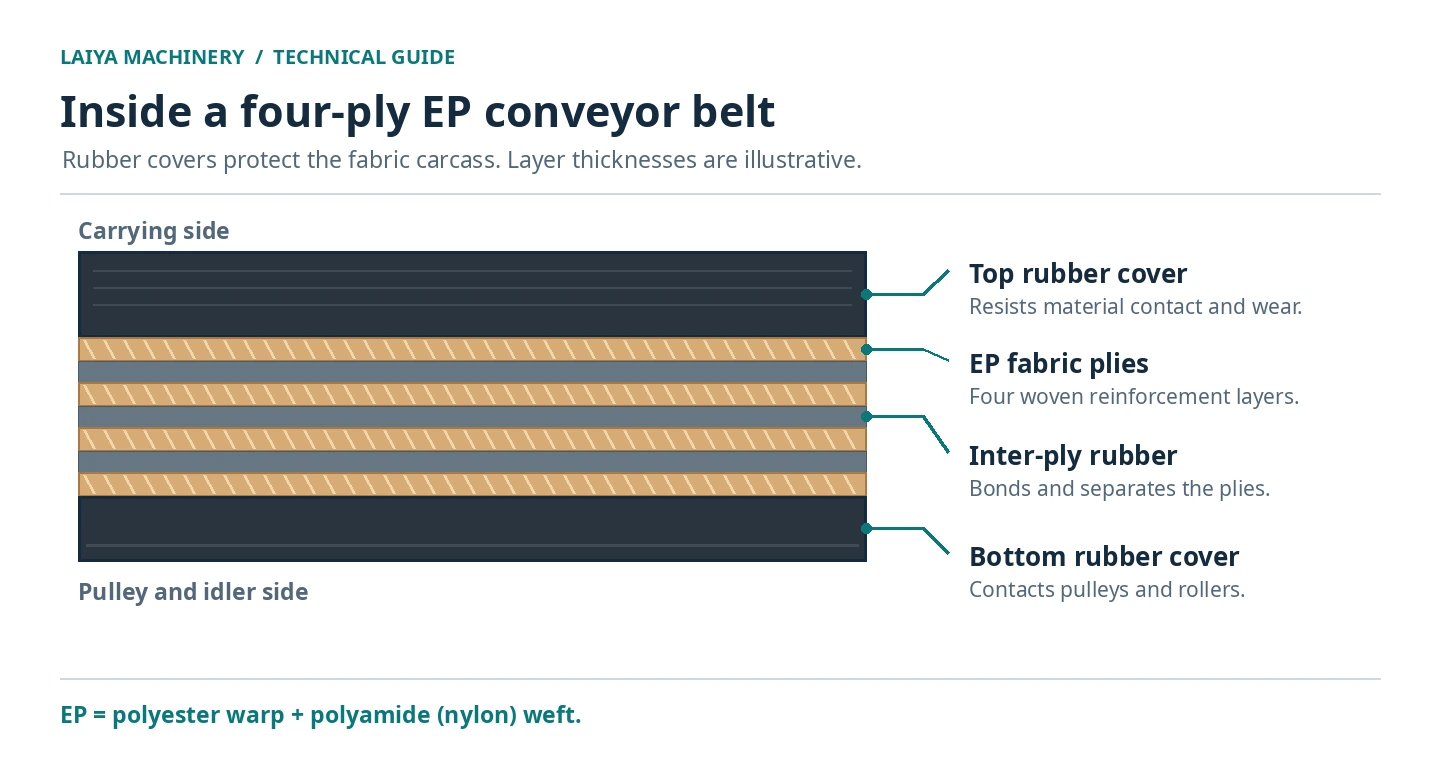
For example, a specification might read 1,000 mm × EP 800/4 × 6+2 mm. Here is how to interpret that designation when the supplier uses a full-belt strength rating:
- 1,000 mm: Belt width.
- EP 800/4: Four fabric plies and a nominal full-thickness tensile strength of 800 N/mm of belt width.
- 6+2 mm: A 6 mm top rubber cover and a 2 mm bottom rubber cover. These are cover dimensions, not the total belt thickness.
Some suppliers use a per-ply rating instead. If EP200 refers to 200 N/mm per ply, four such plies have a nominal combined rating of 800 N/mm. Clarify which convention applies and request the finished belt’s technical data sheet.
Ply count alone does not determine strength or flexibility. Cover rubber tensile strength in MPa is also a different property from the finished belt’s breaking-strength rating in N/mm. Allowable operating tension is lower than the breaking-strength rating and depends on the system design and splice.
3. Choose rubber covers for the actual wear mechanism
For a quarry conveyor, the term “wear-resistant” does not describe every type of damage. Fine aggregate gradually scours the rubber surface, while heavy angular rock may cut or gouge the belt at the loading point.
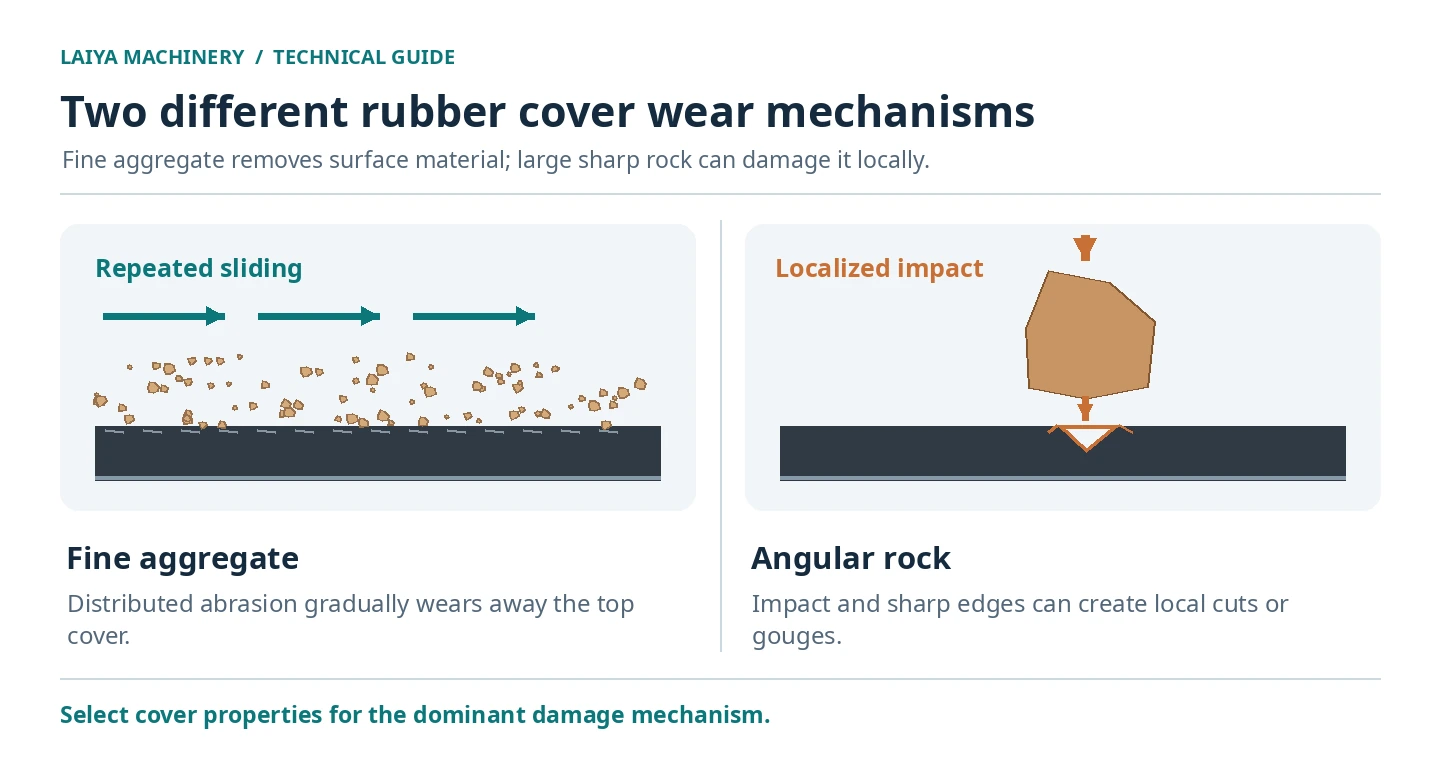
Ask the supplier for the cover grade and test properties. The laboratory abrasion test in ISO 4649:2024 can report relative volume loss. A lower loss under comparable test conditions means less rubber was removed, but it cannot predict the belt’s exact service life. Tensile strength, abrasion loss and resistance to cutting or tearing are separate considerations.
The top cover faces the material; the bottom cover contacts pulleys and rollers. Extra top cover thickness provides more material to wear through, but it cannot correct severe impact, an unsuitable compound or a seized roller. Excessive thickness or stiffness can affect bending around pulleys.
State cover thickness and grade separately in a quotation request. Photographs of premature wear can also help identify which cover properties need improvement.
4. Match belt strength, width and pulley dimensions
For a replacement, obtain the original belt designation and equipment dimensions. In a new system, width depends on capacity, speed, bulk density, loading arrangement and lump size. The rated tensile strength must suit calculated operating tension, considering conveyor length, vertical lift, starting conditions, drive arrangement and splice.
A different carcass may be less flexible. Check the minimum diameters of drive, tail and bend pulleys, troughing arrangement, take-up travel and splice method with your conveyor engineer, especially when changing belt construction.
On inclined conveyors, consider material rollback. A chevron or other profiled belt may suit certain inclines, depending on particle size, moisture, belt speed and equipment. Severe-duty or long-distance systems may need other reinforced constructions after an engineering assessment.
5. Find the cause before replacing a damaged belt
If a belt repeatedly fails in the same location, examine the damage pattern and surrounding equipment before buying an identical replacement.
- Deep damage near the loading point suggests that impact, sharp material or the transfer chute needs investigation.
- Unusual wear on the belt underside may be associated with worn or seized idlers, pulley condition or material buildup.
- Damage along one edge can indicate mistracking, off-center loading or contact with the conveyor structure.
- Premature damage at a splice calls for a review of the joint method, operating tension and splice condition.
Conveyor idlers, impact rollers, pulleys, cleaners and loading equipment all influence performance. Inspection and adjustment should be performed by trained personnel with the equipment safely isolated under the site’s procedures.
6. Compare the cost per tonne of material conveyed
Compare delivered belt cost, installation, replacement frequency and downtime as well as price per metre.
For illustration, assume one belt costs $4,000 delivered plus $800 to install and conveys 300,000 tonnes before replacement. Its simplified direct belt cost is $0.016 per tonne. A second belt costs $5,200 delivered plus $800 to install and conveys 500,000 tonnes, giving a cost of $0.012 per tonne. These figures are hypothetical, not a price quotation or a service-life forecast; actual results depend on your site. Downtime and maintenance costs are excluded from the example.
Agree on comparable specifications and acceptance criteria, then use your own operating history to reassess cost per tonne in service.
7. What to include in a conveyor belt quotation request
When requesting a replacement rubber conveyor belt, provide as much of the following information as possible:
- Material type, maximum lump size, moisture and operating temperature.
- Conveyor position, capacity in tonnes per hour and operating hours.
- Belt width and required length, including whether it is an open roll or an endless belt, and the quantity needed.
- Existing fabric type, full-belt tensile rating, number of plies and top/bottom cover thickness.
- Required cover grade, applicable standard and any agreed test values.
- Conveyor centre distance, inclination, speed, pulley diameters, troughing arrangement and proposed joint method when relevant.
- Existing belt marking, photographs of wear and delivery destination or port.
An example replacement-belt enquiry might state: 1,000 mm wide, 150 m open roll, EP 800/4, 6+2 mm rubber covers, carrying crushed granite, with the maximum lump size and actual throughput supplied separately. Ask the supplier to confirm the cover grade, abrasion test value and total thickness. This is an illustration of how to describe an order, not a recommended belt specification for every plant. Confirm the required roll or endless-belt length and any splice allowance before ordering.
For general surface-use textile conveyor belts, ISO 14890:2026 provides a recognized specification framework. ISO 283:2023 describes tensile strength and elongation testing, and ISO 703:2025 covers transverse flexibility testing. State the standard or equivalent requirements in your order; a reference to a standard is not itself proof of product conformity.
Frequently asked questions
Is an EP conveyor belt suitable for a stone crushing plant?
EP rubber belts suit many aggregate applications. Confirm operating tension, rock size, impact severity, rubber cover and conveyor design for each position in the crushing line.
What does a 6+2 rubber cover mean?
It specifies a 6 mm top cover and a 2 mm bottom cover. The finished belt is thicker because the fabric carcass and internal rubber layers are also part of the construction.
Is a four-ply belt always stronger than a three-ply belt?
No. Compare the finished belt’s nominal tensile rating, not merely the ply count. Confirm flexibility and pulley requirements as well.
Can I get a quote using only belt width and length?
These are necessary dimensions, but they are not enough to identify a reliable replacement. Provide at least the existing belt marking, material, fabric rating and cover thickness, or explain what information is missing.
Request a conveyor belt quotation from LAIYA Machinery
If you are purchasing conveyor belts or related conveyor components for a quarry or stone crushing plant, send LAIYA Machinery your current belt specification, photographs and application details. We can discuss your requirements and prepare a quotation based on the confirmed specifications.
Website: laiyaconveyor.com
WhatsApp: +86 15977775115
Technical references
- ISO 14890:2026 — Textile conveyor belting for general use
- ISO 283:2023 — Tensile strength and elongation testing
- ISO 4649:2024 — Laboratory rubber abrasion testing
- ISO 703:2025 — Transverse flexibility testing
- Dunlop Conveyor Belting — Technical bulletin on abrasion-resistant belting
- Martin Engineering — Foundations, belt support and loading zone considerations